

- Table of contents

Weekly newsletter
No spam. Just the latest releases and tips, interesting articles, and exclusive interviews in your inbox every week.
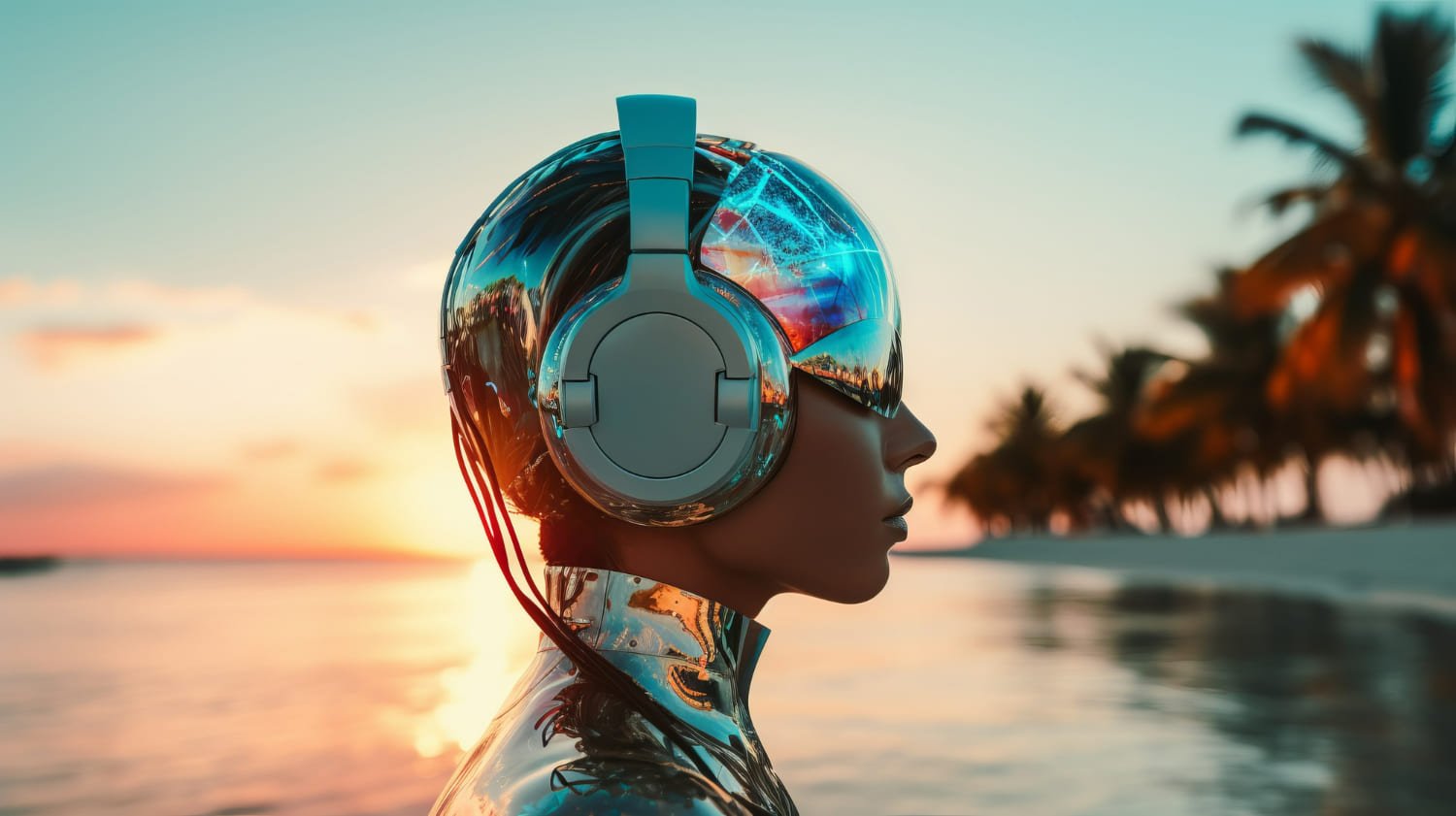
Royalty-Free AI Music: What You Need to Know
Music is an essential component of any content—be it dynamic videos, engaging podcasts, or immersive video games. It sets the mood, enhances emotions, and draws in the audience. However, finding high-quality, affordable, and—most importantly—legal music tracks has always been a significant challenge for creators. The constant risk of copyright infringement can lead to serious consequences such as platform strikes, content takedowns, or even legal action.
Today, artificial intelligence (AI) is revolutionizing the music creation process, making it more accessible, personalized, and customizable than ever before. AI opens up entirely new horizons for content creators, enabling them to generate unique soundtracks that perfectly match their projects. The ongoing challenge of sourcing quality, affordable, and legal music has become more than just a background issue—it is now a direct driving force behind the rise of both royalty-free music and AI-generated compositions.
Content creators have always needed music, but traditional licensing—with recurring royalties and complex negotiations—has been burdensome. This led to a growing demand for simplified licensing models, paving the way for the popularity of royalty-free music.
What Is Royalty-Free Music and Why Is It Important?
Royalty-free music allows creators to use music without paying ongoing royalties or licensing fees for each use. It’s important to understand, however, that the term “free” in “royalty-free” does not mean the music is entirely free of charge. In most cases, users must purchase an initial license or pay a one-time fee to gain usage rights.
People often see the word “free” and assume complete freedom of use, similar to content in the public domain. However, “royalty-free” specifically refers to the payment model—either a one-time purchase or subscription—not the absence of copyright. The music still has an owner who grants usage rights under specific conditions.
Misunderstanding this can lead to accidental violations if the user fails to comply with the license terms, even if they have “purchased” the track. This highlights the fundamental importance of carefully reading and understanding licensing agreements before using any music.
Benefits of Royalty-Free Music for Content Creators
- Cost-Effectiveness: Instead of ongoing royalty payments, creators pay a one-time affordable fee or access music via a subscription, significantly reducing project-related music expenses.
- Legal Compliance: Using royalty-free music is crucial for avoiding copyright infringement issues. It ensures the legal use of music in content, protecting creators from potential lawsuits or takedowns on platforms.
- Wide Selection: Royalty-free music libraries offer access to thousands of tracks across a broad range of genres, moods, and styles, making it easy to find the perfect soundtrack for any project.
Royalty-Free vs. Copyright-Free: Understanding the Difference
It’s critically important to distinguish royalty-free music from copyright-free (or public domain) music.
Copyright-free music can be used entirely free of charge because the creator has waived their rights, or the copyright term has expired, placing the work in the public domain.
In contrast, royalty-free music still has a copyright holder who licenses the music under specific terms. While the payment model is simplified (e.g., one-time fee or subscription), users must still adhere to the conditions of use.
How AI Creates Music: From Concept to Composition
AI models are specialized software systems that use artificial intelligence to create music from scratch. These “musical robots” learn by analyzing thousands of hours of songs to understand complex musical patterns, structures, styles, as well as the principles of harmony, rhythm, and genre conventions.
Based on input—which could be a text prompt (e.g., “uplifting jazz with piano”) or a hummed melody—AI can generate complete musical pieces.
The technology behind these models ranges from autoregressive systems (which predict notes one by one) to diffusion models (which gradually transform random noise into coherent and meaningful music).
Copyright and AI Music: Legal Considerations for Safe Use
At the heart of copyright issues surrounding AI music lies a key tension: the traditional concept of “human authorship” versus the AI’s ability to autonomously generate content. Copyright law has historically been designed to protect works created by human intellect. Since AI is not human, any creation made entirely by AI—without human input—cannot currently be protected under most existing copyright laws.
This means creators must understand that their role isn’t limited to “writing a prompt,” but also includes actively directing and shaping the output so that the resulting work qualifies for copyright protection. In this sense, AI should be viewed as a tool, not the author.
The U.S. Copyright Office (USCO) has made a clear determination:
AI-generated content can only be copyrighted when a human plays a significant role in the creative process.
This means that works generated entirely by AI, without meaningful human involvement, are not eligible for copyright and effectively fall into the public domain.
Human contribution may take many forms, including:
- Writing lyrics and combining them with AI-generated instrumentals
- Manually editing the composition, tempo, or arrangement after AI assistance
- Recording live vocals or instruments over an AI-generated track
- Mixing and mastering AI-generated elements with human audio
Ultimately, it is the “human touch” that transforms AI-generated ideas into copyrightable creative works.
Dos and Don’ts When Using AI-Generated Music (Based on USCO Guidelines)
Don’ts:
- Don’t claim authorship based solely on prompting:
The U.S. Copyright Office (USCO) clearly states that users do not exercise “ultimate creative control” over how AI systems interpret prompts and generate content. If the entire music creation process was left to AI, the result cannot be attributed to a human author. - Don’t credit the AI developer or company as the author:
The AI technology or the company providing it should not be listed as the author or co-author, simply because it was used in the creation process. Authorship must be based on substantial human creative input.
Dos:
- Disclose AI usage in copyright registration:
If a work contains both human and AI contributions, it may still be eligible for copyright protection. When submitting a registration to the USCO, you must disclose that the work includes AI-generated content and provide a brief explanation of the human author’s contribution.
Failing to disclose AI involvement or to prove meaningful human authorship may result in the denial of registration. - Check for other intellectual and personality rights:
Beyond copyright, it’s important to consider other legal risks, even when using royalty-free AI music. These include:
- Personality rights violations: For example, if an AI-generated vocal mimics a well-known artist’s voice, it may infringe on their right of publicity. A real-world case includes Universal Music’s lawsuit over the track Ghostwriter, which imitated Drake’s voice, leading to its removal.
- Unauthorized sampling: If AI was trained using protected material or generates content that resembles it too closely, this could constitute unlicensed sampling.
Even when using AI tools, permission is required unless the sample comes from a licensed, royalty-free library.
- Personality rights violations: For example, if an AI-generated vocal mimics a well-known artist’s voice, it may infringe on their right of publicity. A real-world case includes Universal Music’s lawsuit over the track Ghostwriter, which imitated Drake’s voice, leading to its removal.
This highlights the importance of choosing platforms with transparent and ethical training practices, and being mindful of exactly what the AI is generating.
The Importance of Ethical Platforms and Transparent Licensing
Platforms that ethically train their AI models—for example, Soundverse AI, which explicitly states it does not use copyrighted material in its training data—greatly reduce legal risks for users.
Some platforms (like Soundverse AI) are taking proactive steps by implementing attribution and revenue-sharing mechanisms for artists whose music influenced the AI’s training. This is a forward-thinking approach to addressing ownership and compensation issues in the AI music space.
Where to Find Royalty-Free AI Music: Platform Overview and Licensing Considerations
The market is seeing a growing number of platforms offering AI-generated music. Each platform comes with its own unique features, business models, and—most importantly—licensing terms that content creators must carefully understand. There are significant differences in how various platforms define “royalty-free” and “commercial use.”
Some platforms allow distribution on streaming services, while others explicitly prohibit Content ID registration or distribution altogether. Others may require a separate license for commercial usage. This divergence stems from differing business models, approaches to managing copyright for AI-generated content, and a desire to avoid conflicts with traditional music labels or to retain full control over monetization.
As a result, creators must thoroughly review the licensing terms of each platform, as the label “royalty-free” does not universally guarantee permission for all types of commercial usage or distribution. Misunderstanding these nuances can lead to unexpected legal issues.
Conclusion
Royalty-free AI music opens up unprecedented opportunities for content creators, offering access to a vast range of unique compositions under cost-effective licensing models. This technology allows for reduced production costs, legal compliance, and highly personalized soundtracks for any project.
However, to fully benefit from these advantages—and avoid potential pitfalls—creators must deeply understand both the technical aspects of AI music generation and the complex, evolving legal framework surrounding copyrights.
A key takeaway is the importance of significant human involvement to secure copyright protection for AI-generated music. Simply generating a prompt is not enough—active editing, arranging, and shaping the final work is crucial. Additionally, despite the “royalty-free” label, other legal risks remain—such as violations of personality rights or use of unlicensed training data—which makes careful platform selection essential.
Learn and Discover
See All


